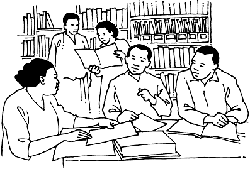
Information plays an important part in the wider learning process
- helping health workers to understand the context of their
work, follow new approaches, undertake new responsibilities,
improve their practice and remind them of basic concepts.
Learning takes place not only at workshops or on training courses,
but also through discussions with colleagues, practical experience,
and consulting newsletters, books and audiovisual materials.
Resource centres can support a wide range of learning activities
by making information available. By helping health workers learn,
they can play a valuable part in improving the health of a nation.
A concern for equity - a key principle of primary health care
- means that information, like health care, should be accessible
to all. But in many developing countries, access to information
is limited, especially information relevant to local conditions.
Locally produced information is often unavailable, while information
produced outside the local area may be inappropriate or too
expensive.
Resource centres have an important part to play in improving
access to information. A resource centre collects and organises
materials that are useful to a particular group of people, such
as health workers. Materials may be very varied, including training
manuals, handbooks, reference books, directories, leaflets,
posters, games, videos and samples of equipment.
However, a resource centre is much more than a collection of
well organised materials. A resource centre actively seeks to
share the information that it contains. Resource centre staff
encourage people to use the materials. For example, they not
only help people to find the materials they need, but they also
disseminate information in the resource centre by producing
and distributing locally adapted materials and information packs,
holding training or discussion workshops, or arranging exhibitions.
A resource centre should aim to:
Development organisations usually prefer the term ‘resource
centre’ to ‘library’ to emphasise that this
is an active, attractive place where people can relax and enjoy
themselves, talk to each other and take part in meetings and
training activities.
A resource centre can be any size, from a trunk of books or
a few shelves, to a whole room or several rooms. A resource
centre may be part of an organisation or an organisation in
its own right. It may serve staff within the same organisation,
people from other organisations, members of the public, or a
mixture. It may be staffed by a volunteer or someone for whom
it is only part of their job, or by a team of professional librarians
and information scientists who are responsible for different
aspects of managing the collection and providing information
services. A collection of materials in a hospital or health
centre meeting room, a few shelves in a room at a training institution,
or a room in a community centre - all these are resource centres.
The larger the resource centre, the more important it is to
have systems for knowing what materials it contains and where
to find them. With a small resource centre consisting of a couple
of bookcases, it is easy for someone to look at all the materials
and find what they need. Perhaps all that is needed is for the
materials to be grouped together by subject, and the shelves
to have labels showing which subjects are where. In a larger
resource centre, however, it would take too long to look through
all the shelves, so it becomes necessary to classify materials
in more detail and list them in a catalogue (for a medium-sized
resource centre) or on a computer database (for a large resource
centre).
Whatever the size, all resource centres have the same aim -
to meet the information needs of a particular group, or groups,
of people.
next: What a resource centre
can do
top of page


 Source
enourages the reproduction of material for non-profit uses. If you
would like to use any of the information in the resouce centre manual
please clearly credit Healthlink Worldwide and send a copy of the
publication to Healthlink Worldwide.
Source
enourages the reproduction of material for non-profit uses. If you
would like to use any of the information in the resouce centre manual
please clearly credit Healthlink Worldwide and send a copy of the
publication to Healthlink Worldwide.