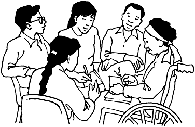
1.3 Developing an action plan
Developing an action plan means turning ideas raised during
strategic planning or evaluation into reality. It means identifying
the steps that need to be taken to achieve the resource centre’s
aims. The resource centre officer and their manager or supervisor
should develop the action plan, in consultation with members
of the resource centre advisory committee and/or other users.
It is useful to have action plans for each area of the resource
centre’s work, such as:
- fundraising
- selecting and ordering materials
- organising materials
- computerisation
- providing information services
- promoting the resource centre
- networking and cooperation.
1.3.1 How to develop an action plan
An action plan consists of seven steps: setting objectives,
assessing the objectives, identifying action required to meet
the objectives, working out how to evaluate the activity, agreeing
a time-frame for action, identifying resources (human, financial
and technical), finalising the plan, and evaluating the results.
1. Set objectives
You need to identify clear objectives that will guide your work
to achieve the resource centre’s aims. Objectives need
to be achievable - do not be over-ambitious. They need to be
measurable (for example, a certain number of activities carried
out within a certain period), so that you can know whether you
have achieved them.
Ask yourself:
- What do we want to achieve?
- Example of an aim: To disseminate information
that will improve local health workers’ knowledge of
local health problems.
- Example of an objective: To produce and
distribute an information pack on malaria diagnosis and management
to all health clinics in the district within the next three
months.
2. Assess the objectives
Assessment helps to determine whether or not the objective is
appropriate. It may result in confirming the objective, abandoning
it or revising it.
Ask yourself:
- Is the objective compatible with the resource centre's aims
and objectives?
- Are the necessary resources (funds, equipment, staff) available
to reach this objective? If not, are they obtainable?
- What problems might arise in working to achieve this objective?
- Example of resources needed to carry out the objective:
staff time, relevant materials in the resource centre or obtainable
from elsewhere, stationery, photocopier, postage.
- Example of revised objective: To produce
and distribute an information pack on malaria diagnosis and
management to 20 health clinics and training institutions
within the next six months.
3. Identify action required to achieve the objective
A series of tasks needs to be identified for the objectives
to be achieved. List these as steps.
Ask yourself:
- What tasks are necessary, in what order, to meet the objective?
Example:
1. Plan the content of the information pack and decide
how to distribute the packs, in consultation with other staff
and users.
2. Calculate costs and staff time, and make
sure that funds and time are available.
3. Allocate responsibilities.
4. Gather information for the pack (search
resource centre, contact other organisations).
5. Request permission from publishers to
photocopy material.
6. Photocopy material and prepare packs.
7. Distribute packs.
4. Work out how to evaluate the activity
Plans for finding out how far the activity has achieved its
objectives need to be built into the action plan.
Ask yourself:
- How will we know whether we have achieved our objectives?
Example:
8. Contact five clinics to see whether
they have received the packs.
9. Include an evaluation form in the pack,
asking health workers whether the information has improved
their knowledge, how they have used the information, and
how future packs could be improved. Assess the feedback
from the forms.
Then incorporate plans for evaluation into your action
plan.
Example (showing plans for evaluation in
bold italics):
1. Plan the content of the information
pack, including evaluation forms, and decide how to distribute
the packs, in consultation with other staff and users.
2. Calculate costs and staff time, and
make sure that funds and time are available.
3. Allocate responsibilities.
4. Gather information for the pack (search
resource centre, contact other organisations).
5. Request permission from publishers
to photocopy material.
6. Prepare evaluation forms.
7. Photocopy material, prepare packs.
8. Distribute packs.
9. Contact clinics to see if they have received
packs.
10. Revise plans for distributing packs if
they have not reached some clinics.
11. Assess the feedback from the evaluation
forms and use it to plan future work.
5. Agree a time frame
As you identify each task, work out how long it will take and
when it needs to be done. This will help you to see whether
your action plan is on schedule or whether you need to modify
the schedule.
Ask yourself:
- What is the actual time required for each individual task?
(Be careful not to under-estimate)
- When will each step be completed?
Example: Total of 18 days over a three-month
period
6. Assess the action plan
Ask yourself:
- How will you know whether the individual tasks have been
achieved?
- Have you allowed for possible interruptions?
- Have you tried to do too much or too little?
An action plan must be realistic if it is to work. It is easy
to over-estimate what you can do, leading to disappointment
and failure. For example:
1. Leaflets that you had planned to include in the pack may
have run out and need to be reprinted. Can you substitute something
else, or will you need to arrange for them to be reprinted before
you can finish preparing the packs?
2. The member of staff preparing the pack will take annual
leave for six weeks during the period in which the pack was
planned to be prepared. Can you re-schedule the work, or can
someone else do it?
7. Finalise the action plan
Revise the action plan. Obtain feedback and comments from colleagues,
and revise it again if necessary.
next: 1.4 Interviewing tips and sample
questions
top of page